

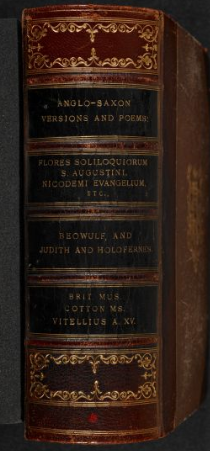
The Southwick and Nowell Codices are two separate codex that were bound together for Sir Robert Cotton. These codex put together is also known as Cotton MS Vitellius A XV as that is what it was referred to as in the Sir Robert Cotton’s Library. Though the original scribes for these codex is not known, it holds many different stories as well as being written in a couple of different languages. These languages include Old English, French, and Latin, and some of the stories also appear to change languages midway. Some of the many stories written in these codex include: Beowulf, Letter of Alexander to Aristotle, Judith, Gospel of Nicodemus, and Homily of St. Quintin just to name a few. The primary owners of this text seems to be Sir Robert Cotton because of the simple fact that it was in his library before it burned, tarnishing some of the manuscript in the process. However, that doesn’t make him the only owner. For example, at the moment the book resides with the British Library where it will more than likely stay for a long time. In fact, while these two manuscripts are tied to libraries, it appears as though the audiences of them may have been more scholarly purposes, at least in our late history. I believe that it may have originally been created for more of an entertainment purpose instead, however, because of the fact that these pieces inside the manuscripts are unfinished and/or seem to have more of a whimsical value to them. An example of this would be the obvious Beowulf because it is the story of a great hero who slays a monster, like most hero’s did in this time period. The outward appearance of this manuscript does seem to be worse for wear. A major part of this being because it was involved in the Cotton fire. Throughout the codex, there are tears and holes, and the edges of the codex for the most part seem to be frayed with burns causing parts of the script to be hard to read. This is more prominent, however, towards the back and more so in the Nowell Codex than in the Southwick Codex. Another downfall of the fire that the codecs were in, is that they were made out of parchment, which in heat, caused the paper to distort some as well as shrink. A good metaphor for what this means would be imagine writing on a balloon while it’s fully inflated. Once the balloon deflates, the text starts to shrink, and with parchment, that can be bad for the ink. That’s just an exaggerated way to say that the fire caused a significant amount of damage to both the contents and the appearance of the outside. There is a lot that could be said about the unique characteristics of this manuscript, for example, how you can tell a visible change for when you switch from one codex to the next. You can also tell the quality of the damage gets more significant the further into the combined codex as you go. Despite this, however, the personal flair of each of this codex doesn’t dissolve into empty space, in fact the combination of them actually, at least to me, seems to be a more unique trait about it as compared to other manuscripts. Something else that is interest is that throughout the codex, there is only one spot where illustration occurs. I’ve tried flipping through the manuscript multiple times, but I only ever find illustrations and illuminations around dead center of the manuscript itself. I could also be incorrect, but these illustrations seem to link up with the story Homily of St. Christopher. I find it interesting that the only place that we find illustrations happens to be in the fantastical story of a Saint, another reason as to why I believe these codices were made with a more entertainment purpose in mind rather than a scholarly in its origin. Something else I found unique about the codex is that the pages of it seems to change color depending on where you read. This can go back to when I stated that you can see a physical change as you switch from one codex to the next, but also it seems to change depending on the story as well. I think this could be a result of some of the stories being incomplete, and the change is where someone else may have come and tried to complete said story, for example. Now while I don’t claim to be an expert when it comes to deciphering these types of books, I did have an enjoyable time going through and trying to decipher all the context clues of this manuscript. That being said, I would take my statements about this manuscript with a grain of salt, but it could also be informative about a different perspective on an ancient piece of art.
 The Southwick and Nowell Codex