
Illustration and Illumination
In this manuscript, the illustrations seem to only show up around the middle of it and never show up again. I believe they start to appear around f.98v-99r and just disappear around f.106v. Through these pages though, there’s only one page that doesn’t seem to hold an illustration of any kind. Since these manuscripts seem to be a collection rather than one big story, maybe these illustrations are only capturing one story rather than all of the stories in the book. The Illustrations in this codex seem to be very bizarre in working, but I don’t believe I’ve found anything that could possibly be illuminated. The colors used seem to be blue, orange, red, and yellow as well as the black of ink. These figures are typically animals or humans, but some of them tend to be anthropomorphic animals, or even half human half animal. On one page, there seems to be a man with a tiny torso and long, extending ears, while on the other page, there is a man offering a leg to another man, like a literal dismembered leg. The lack of illuminations in these illustrations leads me to believe that perhaps this wasn’t something that was able to have a lot of money put into it, but with all the text and the details in the bizarre illustrations, maybe these codex’s were made to be more of entertainment.

Size of the Codices
When it comes to the size of these older manuscripts, we usually talk about the utility of them. For example, we talk about most Books of Hours being either these big godly books that are jewel encrusted, or these small books that are easier to carry around for daily worship. The size of this book, while not looking large, doesn’t look small either. I would wager that while this manuscript couldn’t be carried around for day to day, nor would it probably, it was probably used more as a sort of entertainment piece for the home or library that it stayed at. I don’t believe it would be carried around for long especially because of the context. People of this era would prefer to carry around worship manuscripts than other manuscripts like these. That being said, however, we could also state that the size of the book could possibly be akin to how much money was able to put into making this manuscript. Because it seems to be more plain as compared to other manuscripts we looked at, I don’t believe that the one who commissioned for these codices to be made could spend a lot at the time.
Binding
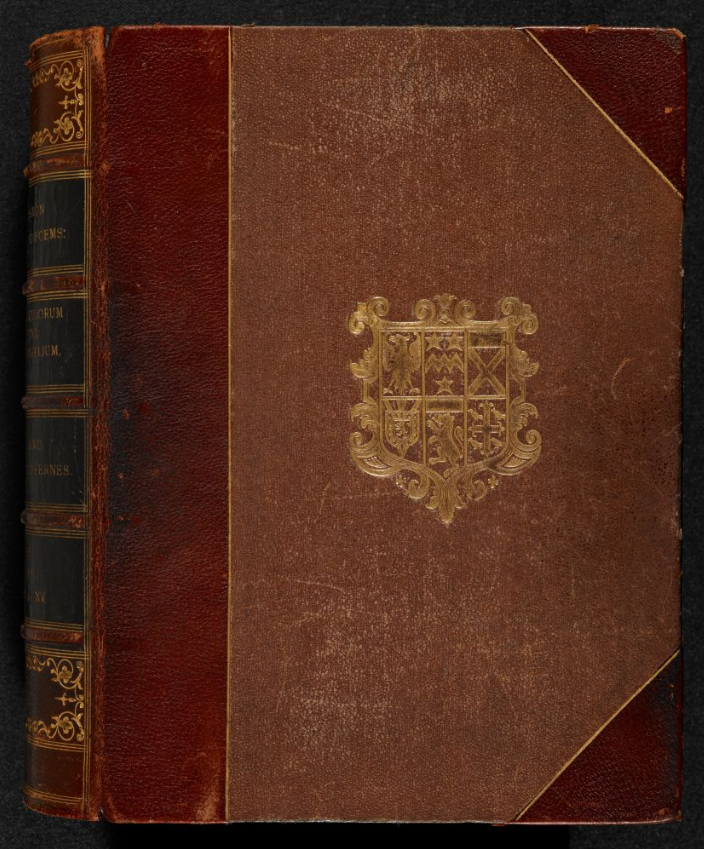
As shown in the introduction, the binding seems to be made of leather with some gold illumination to the outside. It was also stated in the description of the manuscript that the binding was redone and put on after the fact. In fact, I believe that the codices were bound together for the purpose of being put in this cover. It could also be that they were put together after the fact however, but seeing as how both the Southwick and Nowell codices were labeled as one when they were in the Sir Robert Cotton library, I think it’s safe to assume that these were bound together before they needed a new binding by the British Library. You can tell that the binding was put onto the collection later because they have neatly etched the British Library logo into the front and back of the cover. You can also tell that the binding is in a much better condition than the manuscripts that lay inside them. However, even with the binding coming after, there still seems to be some slight damage to the outside of the binding over time, probably from the fact that it was put on almost over 200 years ago still to this day.
Handwriting and Ruling
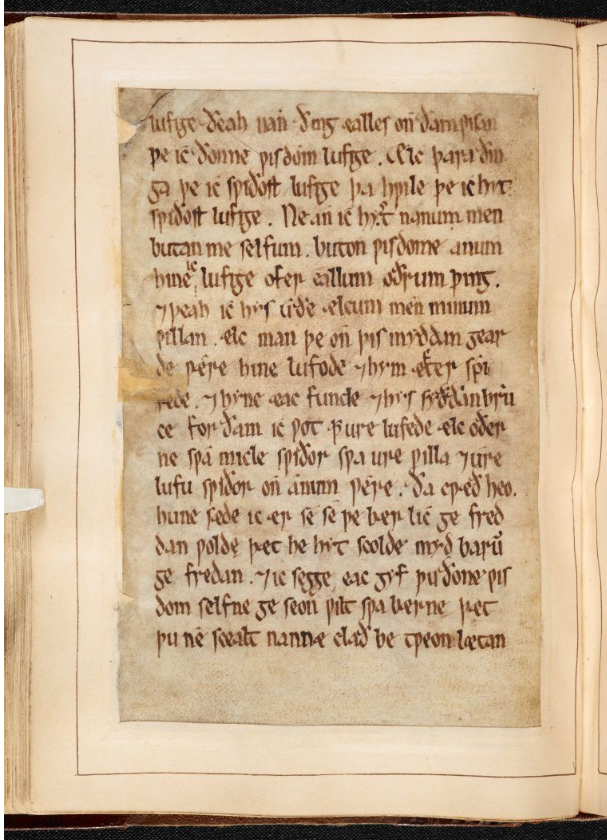
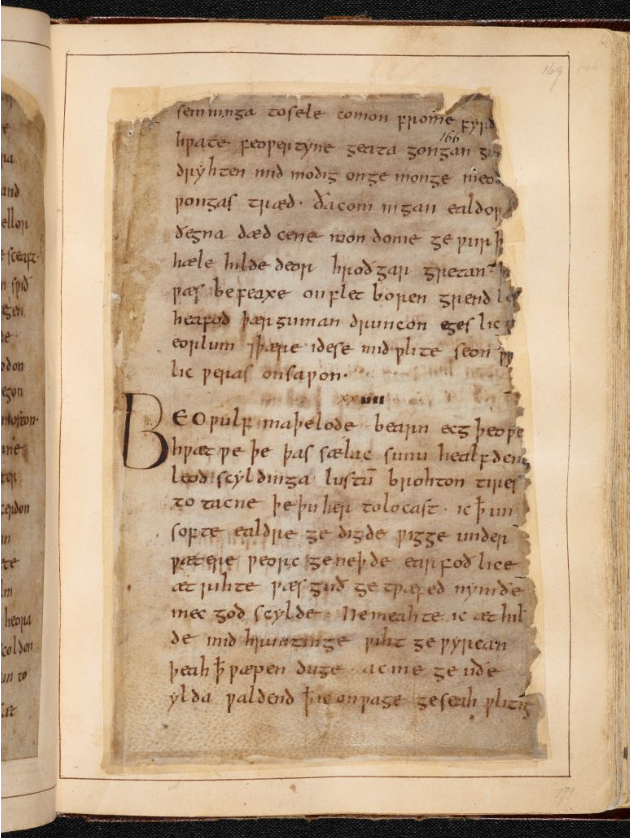
Throughout these two codices, there is a distinct line and a couple of visual cues that show that the book was created by multiple different authors. For one, the language changes throughout the text, some stories being written in Latin, some in French, and some in Old English. Among these, many of the stories seem to even be unfinished. The strange jumping from handwriting and language is one of the aspects that really interested me about this manuscript in particular. Not many books, even when they are pieced together like this seem to have the same affect. The ruling also seems to be peculiar because it seems that either some of the book after the damage was cut, or that they didn’t rule it very spaciously for the time period. The words start at the very top of the page and seem to be a bit cramped during the first part of the Codex. However, later the handwriting changes as well as the spacing of the words. It’s strange to see but also very interesting in my opinion. In the pictures underneath, the page on the left is from the beginning of the manuscript while the one to the right is from the end in order to give context to my stipulations.
Page Material and Quires
The pages of this manuscript are made of parchment and ink, like any other manuscript during this time, especially because it was before paper was properly made. The writing of the script is made in black ink and seems to be made in Luxeuil minuscule, neat and tidy but with long ascenders and descender. There are also many different spots in the manuscript that look like the script may have been erased or faded to the point of not being able to be seen. There are also many different pictures scrawled into the manuscript which are an array of colors like yellow, red, and blue. Besides this, there doesn’t seem to be much color in the manuscript itself. The quire structure seems to be made between the different stories, though it’s hard to tell because it was cut out of its original binding. However despite all the imperfections, the manuscript still seems to be very legible in the writing and the artwork hasn’t faded much over the years.
Para-text
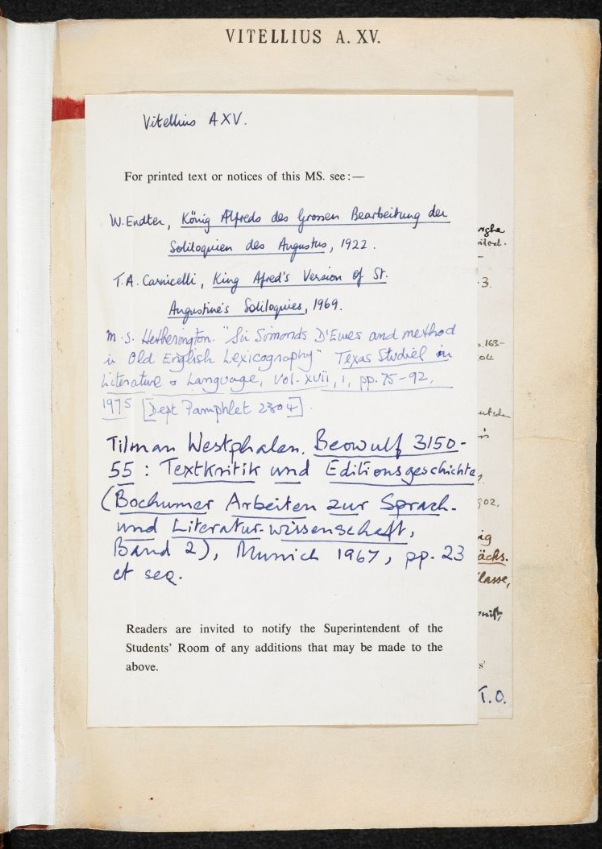
When it comes to possible para-texts in this manuscript, from what I can tell there don’t seem to be any, but at the same time the edges of this manuscript throughout most of it are badly damaged. That being said, it’s very possible that if there were any para-texts to be found, they possibly got destroyed at a later date. Other than that, the very beginning of the book seems to hold an index for the stories. They are numbered and shown in what seem to be titles for each story, along with another stamp form the Britain Museum. This index was added after the fact and inserted into the manuscript. There are a lot of ways that make this obvious, for one it’s in modern English that we can read. Secondly, its written in blue and black ink, which would have been difficult. And lastly, it’s on actual paper, which would have been nearly if not impossible to come by during this time period. However, that being said, there doesn’t seem to be much else that can be found outside of the main text. Most of the para-text was either never there to start with, or burned away in the Cotton Library fire of 1731.
Colors of the Codices
This manuscript does not seem to be very colorful at all, and I believe that it contributes to the idea that I had at the beginning where this manuscript may not have been able to be funded with a large amount of money. With that being said, the colors used seem to be blue, orange, red, and yellow as well as the black of ink. Now besides the black, these other colors only every appear in the illustrations, which also only appear in the middle of the manuscript. Because there isn’t much color in these stories, I think it makes it more believable that maybe these books were created to be of a more intellectual use rather than for the common people. However, through the semester we have talked about people who would get these story type books and read them to the common folk as a sort of mock play for them, entertainment as I said previously. It’s hard for me to really say that the exact purpose of this is, however, because I can’t quite read most of the languages. I do believe that I may be on the right track when it comes to the use of the manuscript though.
The Collections
Now, because these are two different codices, there are a bunch of different stories inside of them. Each one has it’s own collection of Old English texts which most are unfortunately incomplete. Some of the reasons that I believe that they could be incomplete is either because they were damaged beyond repair by the fire, they didn’t have enough money or time to fund making the full manuscript, or possibly that over the years they just got lost in travel. There are many different reasons, but even so the fact that we still have the stories or pieces of the story that we have is a miracle because of the fact that these manuscripts are so old and have suffered so much damage already. Speaking of the different collections, these texts include:
a 17th-century Cottonian flyleaf, a medieval endleaf, Augustine of Hippo’s Soliloquia, the Prose Dialogues of Saturn and Solomon, the Gospel of Nicodemus, homily on St Quintin, homily on St Christopher, Marvels of the East, the letter of Alexander to Aristotle, Beowulf, and Judith. This is a large collection of different texts especially for the time period that they were all created.
 The Southwick and Nowell Codex